Low-latency trading systems NSE · BSE · MCX · Crypto

Everyone sells algo trading. We build the low-latency system underneath it.

An algo is a rule. A system is the feed, the book, the order path and the exits that carry that rule from tick to order in under a millisecond, and through a whole live session without dropping one. That low-latency layer is the part nobody else is selling, and it is the only part we build.

100+ Brokers supported
200-level Depth, decoded
<1 ms Tick to intent
Scroll to see how it is built Strike ladder. Generated in the browser, not market data.
Why us

Production execution without the production surprises.

Every algo shop can show a backtest. What decides whether a system survives a live session is smaller and less glamorous, and it is what we design for first.

  1. Under 1 ms

    Tick to intent, in process.

    Socket read, book update, analytics, decision and risk gate all run in memory. Nothing on that path touches a disk, a lock or the network. The broker leg is the slow part, and the engine is built never to be the slow link behind it.

  2. One cascade

    Every exit, every strategy.

    Stop, target, trail, time limit and expiry buffer evaluate in one fixed order for every open position. A strategy writes a plan and hands off. The engine sells.

  3. Byte for byte

    Yesterday's session, replayed exactly.

    The recorder keeps the raw wire bytes, not a parsed summary. A session replays with order placement off, and its decision log is hashed and diffed against the live run.

  4. Stops itself

    Six independent ways it refuses to trade.

    A daily loss floor, a consecutive-loss switch, a broker-reject cooldown, a stale-feed ladder, a data-feed fatal and a funds check. Each one is independent of the others, each writes its reason to the ledger, and each halts the engine before an operator has to.

End to end

Design, screen, engine, data, and the box it runs on

Five stages, one team. Keep scrolling.

Stage

Design

The spec and the failure modes, written before code.

  • Discovery
  • System design
  • Failure-mode spec
Stage

Dashboard

The dashboard an operator runs the day from.

  • Next.js
  • Live WebSocket
  • Chain and depth boards
  • Prometheus and Grafana
  • Kill switch
Stage

Engine

The order path: feed, signal, risk, OMS, exits.

  • Python
  • C++
  • Cython
  • Broker adapters
Stage

Data

Every order, fill, cost and decision as a row you can query.

  • PostgreSQL
  • Migrations
  • Tick capture
Stage

Box

On your infrastructure, with the runbook. Yours the day we finish.

  • Docker
  • CI/CD
  • Your keys, your static IP
  • Handover
Illustrative field, drawn in the browser
Broker APIs Any broker · any venue

Built against the brokers your desk already uses

Point at any planet to see what that broker's API gives you: depth levels, order limits, brokerage and the API fee, from their own documentation.

Zerodha KiteUpstoxDhanAngel OneFyers5paisaICICI DirectKotak NeoHDFC SkyMotilal OswalIIFL SecuritiesAlice BlueShoonyaPaytm MoneyGrowwSharekhanNuvamaChoiceSamcoFlattradeJainamBigulFirstockZebuMaster TrustGoodwillTradejiniProStocksTradeSmartAxis DirectSBI SecuritiesAnand RathiGeojitReligareVenturaStoxkartm.StockBajaj BrokingRupeezyIndira SecuritiesSAS OnlineLemonnINDmoneyJM FinancialNirmal BangEspresso
NSEBSEMCXNCDEXGIFT NiftySymphony XTSTrueDataGlobal DatafeedsDhan Data APIKite ConnectDelta ExchangeCoinDCXBinanceBybitOKX
Any broker API your desk already uses
3,000+ strategy candidates tested before one ships
200 depth levels decoded, every tick
<1ms tick to intent, in process
Who we build for

Three kinds of desk, one kind of problem

You have the capital or the edge. The system underneath is the part we build and hand over.

Prop desks

Your capital, your rules, our execution core.

Low-latency pathMulti-strategyRisk gate

Institutions and funds

An order path your compliance function can read.

AuditableReplayableDocumented

Traders with an edge

A method that works by hand, run without you.

AutomationExitsPaper first
What we build

Eleven systems, one spine

Every engagement is some combination of these. Hover one.

Low-latency execution engine

Book decoding to submission on one hot loop.

C++17CythonLock-free

Strategy automation

Your rules, running unattended, the same on day forty.

on_tickRegime routerKill switch

Real-time market scanner

Every strike on every tick, filtered to the few that matter now.

OI shiftsIV rankSweepsAlerts

Copy trading and replication

One decision, many accounts, each with its own caps.

Master and followersPer-account sizingTagged

Multi-broker integration

Each venue on its own adapter, capabilities declared at boot.

DhanUpstoxFyersAngel One

Option chain and OI analytics

A live chain with your own Greeks and OI boards.

Black-76OI by strikePCR

Backtesting and research

Yesterday's wire bytes, replayed and diffed.

Wire captureReplaySealed holdout

Risk and compliance layer

One gate before the OMS; floors that scale with capital.

R:R floorDaily floorAudit trail

Operator dashboards

Health lamps, the position book, the ledger, the log.

Next.jsWebSocketGrafana

Crypto execution

The same engine, a 24/7 session and a funding-aware cost model.

Spot and perps24/7 clockOne adapter

Rescue and audit

A system somebody else built, read, fixed and documented.

ForensicsReplay the bad dayRunbook
Architecture

Tick to trade, the whole path

A tick leaves the exchange and comes back as a fill. Scroll it through. Point at the book. Send an order.

Station 1 of 8

Exchange

A tick leaves the matching engine.

Illustrative. Generated in the browser, not market data Scroll to move the tick
Order management

An order is a state machine, not a REST call

place_order() returns an acknowledgement, sometimes. Scroll the order through.

NEWSUBMITTEDACKNOWLEDGEDIOC GRACEFILLED
NEW

Accepted by risk. An ID is minted before anything leaves the process.

Idempotent client IDsTranche-aware fillsUNCERTAIN is a stateDurable per transition
· Why this practice

What goes wrong with the other quote

We hear these five complaints most often about the last vendor, and each one is something we handle differently, on purpose.
Selected work

Systems that have taken a live session

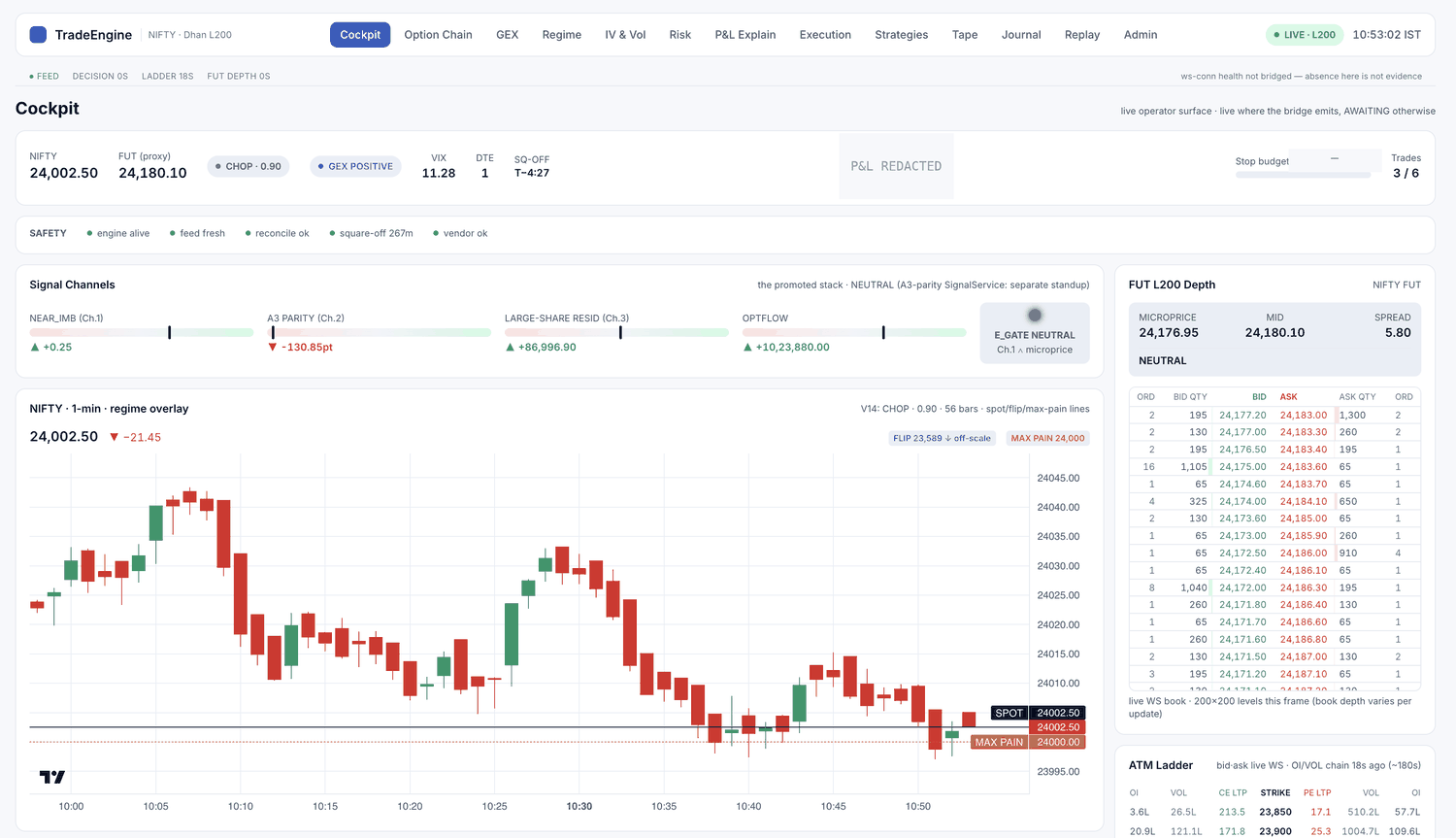
The TradeEngine cockpit during a live session, showing the NIFTY chart with a regime overlay, signal channels, and a 200-level depth ladder. Session P&L figures are redacted.

Intraday options engine

A production intraday options engine on a 200-level depth feed. It streams NIFTY and BANKNIFTY weeklies, routes between strategies on a regime classifier and manages every exit through one cascade. Deterministic replay, a Postgres ledger and Prometheus metrics, so any session can be reproduced tick for tick months later.
StackPython · Cython · asyncio · Postgres
StatusLive
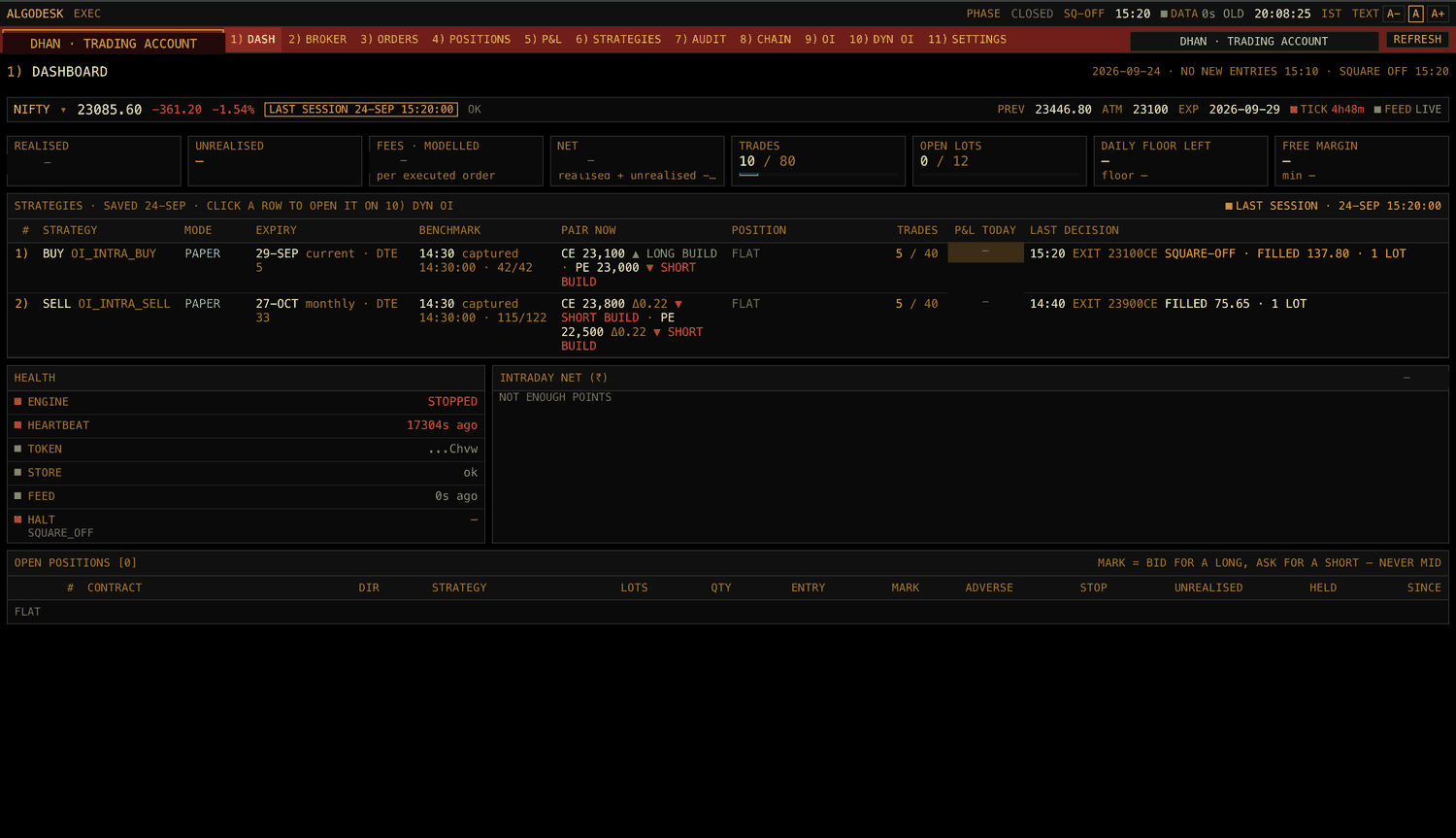
The client desk dashboard during a session, showing the strategy table with modes and expiries, the health lamps, the open position book and the session counters. Money figures are removed.

Private trading desk & control plane

A complete desk for one client. Engine, web control plane and eleven operator screens. He pastes his broker token, presses start, and watches the chain, the OI boards and the decision tape. Paper and live are separate rungs, and the switch between them is a deliberate act with a confirmation.

StackFastAPI · Next.js · Postgres · Docker
DeliveryDeployed & handed over
Writing

Latest from the blog

Notes from building execution systems for Indian options desks. Written for the engineer who has to run one, not for the search engine.

Where the latency actually goes

A tick-to-order budget for a NIFTY weekly options engine on a retail broker API, and why the broker leg, not your code, sets the floor.

5 min read

Replaying a live session byte for byte

Record the wire bytes, not the parsed ticks, hash the decision log, and never grade a change on the first half of a tape.

5 min read

Exits, not entries, decide whether an algo survives

One exit cascade for every strategy, a fixed evaluation order, and a risk gate that sits in front of the OMS instead of inside any strategy.

5 min read
Start a project

Tell us what breaks

The more specific you are, the more useful the first reply. Broker, product, and what the current system does wrong beats "I want an algo".

Good fits

Prop desks needing an execution or risk layer · traders with a proven manual edge to automate · fintech teams who need an order path they can trust · anyone holding an engine they cannot debug.

Not a fit

"Build me a strategy that makes X% a month." We build systems that execute your strategy correctly. We do not sell signals, tips or returns.

Opens your email app with the details filled in.
Next

Let's work together.

LinkedIn Start a project
India · IST--:--:--

Is your order path ready for a live session?

Let's work together.
LinkedIn Start a project
India · IST--:--:--
Next

Let's work together.

LinkedIn Start a project
India · IST--:--:--
Based in
India, working in IST
Building for
Prop desks, funds and independent traders
Stack
C++, Python, Postgres, Next.js
Devesh Maan, quantitative developer. A studio-graded portrait in the site's black and gold.
Devesh Maan · Quantitative developer
Contact
LinkedIn
Elsewhere
GitHub
Availability
Taking new engagements
LinkedIn Start a project
India · IST--:--:--